Date Published 07 October 2026
Nowadays when you mention Highgate, most people will think of its charming high street, historic buildings, expansive views or leafy parks. Fifty years ago, however, invoking the name of this cosy North London village brought much spookier things to mind.
In the late 1960's and early 70's, Highgate was the site of a number of mysterious encounters with what seemed a distinctly inhuman being, and speculation that a real live vampire stalked Highgate Cemetery was widespread. But whilst it was never confirmed whether the strange sightings were truly brushes with the supernatural, the verified human saga that unfolded as a result was arguably even stranger.
The story begins in 1969 when people allegedly began reporting similar experiences in and around Highgate Cemetery. An elderly woman who had been walking her dog on Swains Lane described a sudden, dramatic drop in the temperature followed by the appearance of an extremely tall, cloaked figure with glowing red eyes that then seemed to vanish into thin air. A middle-aged accountant who'd been visiting the cemetery on a different night had a story that closely matched. A young local occultist named David Farrant said he spoke to the witnesses and initially attempted to debunk the ghostly rumours by spending a night in the cemetery himself. He instead came away from the experiment claiming to have had a nearly identical encounter.
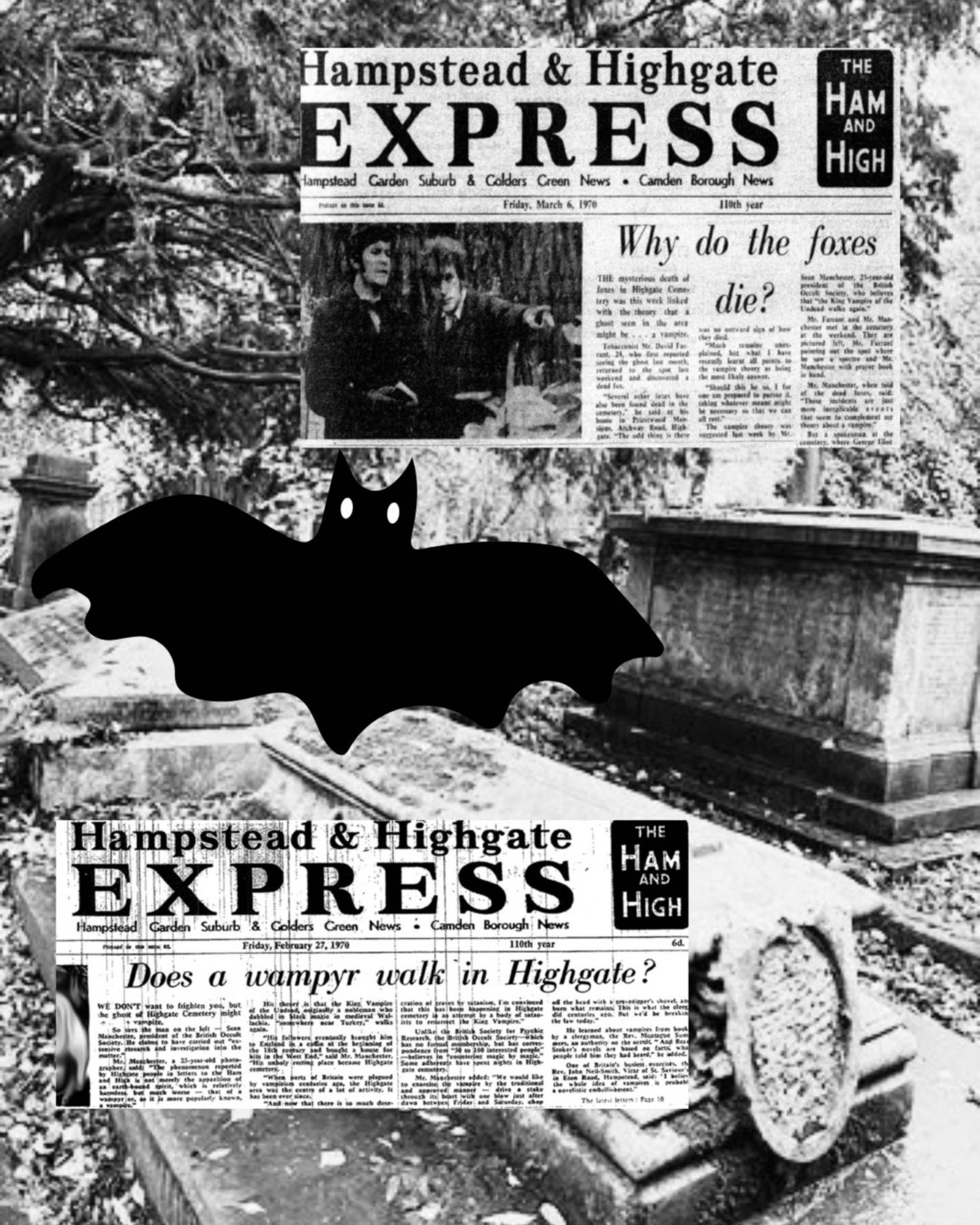
Farrant wrote a letter to the Ham & High describing what he had seen. The paper published his account and news of the spectre quickly spread. The story caught the attention of another young man, Sean Manchester, who wrote in positing that the apparition was a ‘King Vampire' who had been buried in Highgate centuries earlier and recently re-awoken by Satanists performing rituals in the cemetery. He claimed to have interviewed some local teenage girls who told of a figure trying to enter their bedrooms late at night, and of waking up with puncture wounds, scratches and symptoms of anaemia after seeing the glowing red eyes on Swains Lane. On 27th February 1970, the Ham & High ran with the headline ‘Does a wampyr (sic) walk in Highgate?' on its front page.
That spring, the paper ran regular stories following the case, and the national media soon joined as well. ITV aired a programme about the vampire on Friday 13th March in which Farrant, Manchester and other witnesses were featured. That same night, hundreds of people descended upon Highgate Cemetery hoping to slay the vampire. After many hours, the police managed to clear the crowd of zealous Van Helsings, but the incident was to be the first of many as occult rituals and grave desecrations became regular occurrences.
Meanwhile, as the furore continued, Farrant and Manchester found themselves increasingly at odds. Both were certain that an otherworldly being was in their midst, but Farrant disagreed that it was a vampire. He and fellow Wiccans determined it was a malignant spirit after summoning it in the cemetery, and believed that exorcisms and magic spells were the keys to protecting the public. Manchester, on the other hand, doubled down on his initial assessment and led a group that doggedly hunted the vampire for the next several years. The feud reached fever pitch in April 1973 when flyers were posted in Highgate tube station announcing that the two would face off in a magic duel at Parliament Hill on Friday the 13th (although this never came to pass).
In 1974, Manchester claimed that he discovered the vampire's casket in the basement of an abandoned house in Crouch End and drove a wooden stake through the monster's heart, killing it once and for all. That same year, Farrant was convicted of vandalism and interfering with human remains in Highgate Cemetery (though he maintained his innocence throughout his life) and jailed as a result. In the wake of these two events, the public frenzy surrounding the Highgate Vampire began to cool down.
What stayed red-hot, however, was Farrant and Manchester's rivalry. Both remained active in the world of paranormal investigation, with Farrant becoming a Wiccan high priest and president of the British Psychic & Occult Society, and Manchester being ordained as a bishop of the British Old Catholic Church. From these positions, they continued to argue about whether there had been a vampire in Highgate and threw personal jabs via interviews, articles, books and online forums for decades. When Farrant passed away in 2019, however, Manchester acknowledged the outsize role his longtime adversary had played in his life. He paid tribute with a brief, solemn Facebook post that concluded; ‘though he might not want my prayers, he has them anyway.'
To this day, the existence of the Highgate Vampire remains controversial. But no matter who you agree with, one thing is for sure: sometimes the known happenings in Highgate are just as strange as the mysteries.